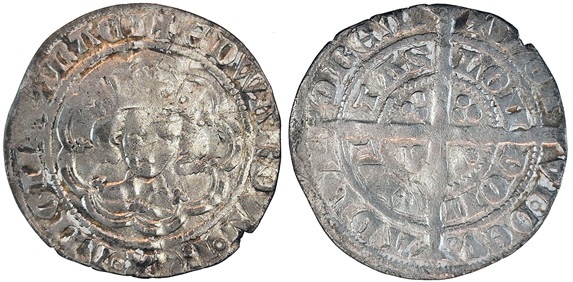
These are some of the medieval European coins I have. This isn't a collection with any particular purpose or direction
- just 50 or so odd coins that I have aquired. For this section I have included coins up to the year 1500, though most historians put the end
of the medieval at 1453 or the fall of Constantianople. for Papal States coins before 1500 see the Papal States page.
Historical Note: Herbert I of Maine, known as “Wakedog,” was a vigilant and aggressive ruler whose
constant conflicts with the Counts of Anjou shaped the political landscape of western France in the early 11th century.
Captured and imprisoned by Fulk Nerra between 1025 and 1026, Herbert lost territory but maintained his authority upon release.
His numismatic legacy is significant: between 1020 and 1030 he introduced a new denier type featuring his monogram
(HERBERTUS), a stylized assertion of comital identity. Despite this personal mark, the reverse inscription
SIGNVM DEI VIVI (“the symbol of the living God”) preserved the long‑standing connection between Maine’s coinage
and ecclesiastical authority. These deniers became the standard for the county for generations.
French Feudal State – Counts of Maine – Herbert I “Wakedog” (1015–1036)
Mint: Le Mans
+ COMES CENOMANNIS
Cross within circle, legend around
French Feudal State – Bishopric of Clermont (1030-1060)
The Évêché de Clermont — the medieval Bishopric of Clermont in Auvergne — was one of the most influential ecclesiastical lordships in central France.
Centered on the ancient city of Clermont (known in Latin as Arverna), the bishopric held both spiritual authority and substantial temporal power,
often functioning as the effective ruler of the region during the early and high Middle Ages. Its bishops issued their own coinage, including the
deniers bearing the Carolignian‑style monogram on the obverse and the +ARAVERNA legend on the reverse, a proud reference to the ancient Arverni
people and their territory.
Details
Ruler
Image
Eveche de Clermont, Denier (ND 1030-1060)
Mint: Auvergne
Obverse:
+ ARVERNA
VBS monogram surrounded by legend
Historical Note: The Bishopric of Clermont—today’s Clermont‑Ferrand—was both a spiritual and temporal
power in medieval France. Its bishops exercised secular authority and held the right to mint coinage, a privilege that
reinforced their influence across the region of Auvergne. The obverse inscription SCA MARIA (“Saint Mary”) reflects
the ecclesiastical identity of the issuing authority, while the reverse legend VRBS ARVERNA (“City of Auvergne”)
asserts jurisdiction over the wider region. Aimeric, bishop from 1111 to 1150, is the most likely issuing authority for
this type, which fits stylistically and chronologically within his long episcopate.
French Feudal State – Duke of Aquitaine / Count of Poitiers – William X (1127–1137)
As Count of Poitiers, William X presided over a city that served as the principal seat of the Duchy. This mint was vital for managing the complex economy of southwestern France, a region defined by its role as a strategic borderland and a hub for trade routes stretching from the Loire to the Pyrenees.
Details
Ruler
Image
French Feudal State – Duke of Aquitaine / Count of Poitiers – William X (ND 1127–1137) Denier
Mint: Bordeaux
Obverse:
+ GLVILILMO
“William”; four small crosses arranged in a cross pattern, legend surrounding
Reverse:
+ BVRDEGIIILA
“Bordeaux”; large central cross with surrounding legend
Historical Note: William X, sometimes called “the Saint,” was the last male Duke of Aquitaine of the
Ramnulfid line. Upon his death in 1137, his vast domains passed to his daughter Eleanor — the future Eleanor of Aquitaine —
whose inheritance reshaped the political map of medieval Europe. Eleanor continued issuing deniers in the style of her father,
and the Poitiers–Bordeaux coinage became a cornerstone of the Angevin monetary system after her marriage to Henry II of England.
French Feudal State – Viscountcy of Albi (1074–1250)
The Viscountcy of Albi, located in the Languedoc region of France, was ruled by the influential House of Trencavel,
who also held the viscounties of Carcassonne, Béziers, and Nîmes. The denier below is attributed to Bernard Aton IV
Trencavel (ruled 1074–1129) or one of his immediate successors. The obverse legend + IAMVIVMD is a degenerate
rendering of “BERNARDUS ATONUS,” reflecting the stylized and often corrupted legends typical of southern French
feudal coinage. The region had a significant Cathar presence, and the Trencavel viscounts were known for their
tolerance during a period of increasing religious tension.
Details
Ruler
Image
Viscountcy of Albi – Bernard Aton IV Trencavel Denier (ND 1074–1129) or Successor
Historical Note: The Trencavel dynasty played a central role in the political and cultural life of
Languedoc. Their coinage reflects both regional identity and the artistic tendencies of southern French mints, where
legends frequently became stylized or corrupted over generations of copying. The ambiguous reverse design—possibly a
crozier, possibly a symbolic monogram—remains debated among numismatists, highlighting the interpretive challenges of
medieval feudal issues.
French Feudal State – Comtes d’Angoulême et de la Marche (1180–1220)
The counts of Angoulême and La Marche issued deniers with an immobilized legend honoring the long‑dead Carolingian king
Louis IV (936–954). The reverse inscription EGOLISSIME is a medieval form of “Angoulême.” By striking coins in the
name of Louis IV, the counts emphasized that their minting rights were ancient and legitimate, rooted in royal authority
rather than recent usurpation. The obverse design reflects ecclesiastical influence, while the reverse motif of five circles
(one containing a crescent and cross) may symbolize the Five Wounds of Christ or simply represent a stylized cross, as
engravers often worked with limited artistic precision.
Details
Ruler
Image
Comtes d’Angoulême et de la Marche – Anonymous Issue Denier (ND 1180–1220)
Mint: Angoulême / Chabanals
Obverse:
+ LODOICVS
“Louis”; cross
Reverse:
EGOLISSIME
“Angoulême”; cross cantoned with three rings and a crescent
French feudal state, Archbishopic of Vienne (ND 1150-1200) Denier
Located on the Rhône River, Vienne sat at a strategic intersection of trade and religion. Throughout this period, the city was a site of major events,
most notably hosting the Council of Vienne (1311–1312), where Pope Clement V famously dissolved the Knights Templar. The anonymous deniers struck between 1150-1200
were minted under 3 archbishops, Stephen II (c. 1155–1163), Robert de La Tour du Pin (c. 1170–1195) and Aynard de Moirans (1195–c. 1205).
The Archbishopric of Vienne became a direct vassal of the Holy Roman Empire around 1032, when the Kingdom of Burgundy (Arles)
was absorbed into the Empire under Conrad II. The archbishops, already powerful landholders, were granted Imperial immediacy,
making them Princes of the Empire and independent of local counts. Their status was strengthened by privileges issued by
Emperor Frederick I Barbarossa in the 12th century.
By the 14th century, French influence increasingly overshadowed Imperial authority in the region. The Archbishopric was
formally annexed by France in 1450 under an agreement between King Charles VII and Emperor Frederick III. The legend
MAXIMA GALL (“Great Gaul”) on the coinage reflects this growing orientation toward France rather than the Empire.
Details
Ruler
Image
Archbishopic of Vienne – Anonymous Issue Denier (ND 1150-1200)
Mint: Vienne
Obverse:
.
.
.
✠•S•M•VIENNA
Berded head of Saint Mauritius facing left
Reverse:
MAXIMA•GALL
Cross with four pellets in angles.
Historical Note: This coin feature the bearded head of Saint Maurice who was a revered early Christian martyr
and the patron saint of the cathedral in Vienne. the reverse "Maxima Gallia" (Great Gaul) is a reminder that the city was a major Roman colony and provincial capital
French Feudal State – Abbey of Saint‑Martial (1106–1245)
The Abbey of Saint‑Martial in Limoges was a major monastic and cultural center in medieval France. While many French abbeys
minted coins, those of Saint‑Martial are distinctive because they were issued under the direct authority of the abbot rather
than a bishop or secular lord. The obverse legend SES • MARCIAL invokes Saint Martial, the abbey’s revered patron, while
the reverse inscription LEMOVICENSIS refers to the city of Limoges itself. These unusual legends reflect both local
devotion and the abbey’s assertion of independent minting rights.
Details
Ruler
Image
Abbey of Saint‑Martial – Anonymous Issue Denier (ND 1106–1245)
Mint: Limoges
Obverse:
.
SES • MARCIAL
Bearded portrait of Saint Martial in an inner circle; legend beginning at 19h
Reverse:
+ LEMOVICENSIS
Cross with four pairs of dots within an inner circle; legend around
Historical Note: Saint‑Martial’s coinage stands apart from most ecclesiastical issues in France because
it reflects the abbey’s unique autonomy. The portrait of Saint Martial emphasizes the abbey’s spiritual authority, while
the reverse legend ties the issue directly to Limoges. These deniers circulated widely in the Limousin region and testify
to the abbey’s economic and religious influence during the High Middle Ages.
French Feudal State – Viscounts of Béarn (Lord of Forcas) (c. 1080–1250)
The Viscounts of Béarn ruled a semi‑independent lordship in the Pyrenees region of southwestern France. Their authority grew
over the centuries, and Béarn eventually functioned as an autonomous principality before being absorbed into the Kingdom of
France. The inscription ONOR FORCAS on Béarnese coinage does not refer to a person; it proclaims the viscount’s
right of the gallows — the authority to administer high and medium justice. This was one of the most important
feudal privileges, symbolizing a lord’s power over life and death within his domain.
The obverse legend CENTVLLO COM abbreviates “Centullo Comes,” referring originally to Centule V of Béarn (d. 1090), a
powerful viscount who greatly expanded Béarn’s autonomy. The inscription became “immobilized,” remaining unchanged for
generations even when later rulers bore different names. This continuity emphasized the antiquity and legitimacy of Béarn’s
minting rights.
Details
Ruler
Image
Viscounts of Béarn – Immobilized Issue Denier (ND 1080–1250)
Mint: Morlaàs
Obverse:
CENTVLLO COM
Cross with a pellet in two angles
Reverse:
PAX ONOR FORCAS
“Peace; Right of the Gallows”; PA+ framing a triangle
Historical Note: Béarn’s coinage is among the most distinctive of medieval France. The repeated use of
Centule V’s name long after his death reflects the viscounts’ desire to emphasize continuity and legitimacy. The bold
invocation of judicial authority on the reverse — ONOR FORCAS — is unique in European numismatics and underscores
the remarkable autonomy Béarn enjoyed during the High Middle Ages.
French Feudal State – Saint‑Martin de Tours (12th–early 13th centuries)
The deniers minted at Saint‑Martin de Tours formed part of the broader feudal coinage system of medieval France. These coins
typically feature the distinctive château tournois — a stylized castle design that evolved from the hexastyle temple
motif seen on the coinage of Louis the Pious around 800. The obverse legend SCS MARTINVS invokes Saint Martin, the
abbey’s patron and one of the most venerated saints in medieval France.
The abbey’s right to mint coins symbolized its considerable autonomy and influence in the region of Touraine. This privilege
ended in 1204 when King Philip II Augustus incorporated Touraine into the royal domain, bringing its mints under direct royal
control. During the earlier Abbatial Period, the powerful counts of Blois and Anjou often served as lay‑abbots, exercising
economic and military authority — including control of the mint — while clerical abbots oversaw spiritual matters. This
arrangement reflects the complex interplay between secular and ecclesiastical power in medieval France.
French Feudal State – Brittany – John I (1237–1286)
The denier of John I, Duke of Brittany, is among the earliest Breton coins to display the new heraldic arms of the House of
Dreux. John I, known as “John the Red,” introduced the ermine‑patterned shield that would become the enduring emblem of
Brittany. A prominent crusader and close advisor to King Louis IX of France, John I strengthened both the political and
symbolic identity of the duchy through his coinage.
Details
Ruler
Image
Brittany – John I “the Red” Denier (ND 1237–1286)
Mint: Rennes
Obverse:
+ B RIT ANI E
“of Brittany”; triangular Dreux shield with ermine quarter
Reverse:
+ IOHANNES DUX
“John, duke”; cross pattée
Historical Note: John I’s adoption of the ermine shield on his coinage marked a turning point in
Breton heraldry. The Dreux arms became inseparable from the identity of Brittany, appearing on seals, banners, and
coinage for centuries. His reign also coincided with the consolidation of ducal authority and closer ties to the French
crown, reinforced through his participation in the Crusades and his service to Louis IX.
French Feudal State – Archbishopric of Lyon (1150–1250)
The legend PRIMA SEDES proclaims Lyon as the “First See of Gaul.” This reflects the longstanding tradition that
Christianity first took root in France at Lugdunum (Lyon), giving the Archbishop of Lyon primatial authority over the other
bishops of the region. The coins of this period feature a large cruciform “L,” representing Lugdunum, the Latin name
for Lyon. The cross at the top of the letter emphasizes the ecclesiastical authority of the archbishop. The surrounding
legend, + PRIMA SEDES, reinforces Lyon’s claim to primacy.
Details
Ruler
Image
Archbishopric of Lyon – Anonymous Issue 1/2 Denier (ND 1150–1250)
Mint: Lyon
Obverse:
PRIMA SEDES
“First See”; large cruciform L
Historical Note: Lyon’s claim to primacy dates back to late antiquity, when the city was the
administrative and religious center of Roman Gaul. The cruciform L on these coins is one of the most distinctive
ecclesiastical symbols in French feudal numismatics, combining civic identity with spiritual authority. These small
half‑deniers circulated widely throughout the Rhône valley and helped reinforce the archbishop’s temporal influence.
Archbishopric of Lyon – Anonymous Issue (1150–1250)
Mint: Lyon
Obverse:
PRIMA SEDES
“First See”; large cruciform L
Historical Note: This second example follows the same immobilized design used for roughly a century.
The consistency of the type reflects both the archbishopric’s stable authority and the strong regional identity of Lyon’s
coinage. The cruciform L remained one of the most recognizable symbols of ecclesiastical minting in medieval France.
France – Charles VI
Details
Ruler
Image
France – Charles VI Gros (ND 1417–1420)
Mint: Tournai
Obverse:
+ KAROLVS FRANCORV REX
Three fleurs‑de‑lis (2‑and‑1) beneath a wreath
Reverse:
:
:
+ SIT NOME: DNI: BENEDICTV
Cross fleur de lis; crowns in quarters 2 and 3
Historical Note: This gros was struck during the turbulent later years of Charles VI’s reign, a period
marked by civil war between the Armagnacs and Burgundians and the ongoing pressures of the Hundred Years’ War. Despite the
political instability, the Tournai mint continued to produce high‑quality royal coinage featuring the traditional fleurs‑de‑lis
and religious inscriptions affirming divine blessing on the French monarchy.
Belgium – John I of Brabant
Details
Ruler
Image
John I of Brabant - Sterling, Crockard type (ND 1287-1294)
Mint: Maastricht
Obverse:
+I DVX LIMBVRGIЄ
Bust facing, wearing chaplet of roses.
Reverse:
DVX BRA BAn TIЄ
long cross, breaking through a pearl circle, four groups of three balls between the arms of the cross and the circle
Historical Note: Gaucher V of Châtillon served as Constable of France and held the Lordship of
Florennes in the early 14th century. His coinage reflects both French feudal influence and the distinctive regional
traditions of the Low Countries. The crowned bust and long cross are typical of northern European pennies of the period,
while the legends emphasize his comital authority and the introduction of a “new money” at the Yve mint.
Italian State – Genoa (Republic) (1139–1339)
The term grosso simply means “large” and was applied to the new, heavier silver coins that began appearing across Europe
in the 13th century, replacing the smaller denaro. Genoa first minted the grosso around 1172, marking a major step forward from
earlier coinage. During the period of the Genoese Commune (1139–1339), these coins became a symbol of the republic’s growing
commercial and political power.
The obverse legend IANVA derives from the Latin word for “door,” the origin of the name Genoa, and is represented by the
gate motif on the coin. The reverse inscription CVNRADI REX (“King Conrad”) refers to Conrad III, who died in 1152. This
is an example of immobilized coinage: Genoa continued to use the name of a long‑dead emperor to acknowledge an ancient legal
grant of minting rights while simultaneously asserting its practical independence from the Holy Roman Empire. It was a clever
balance of legal deference and republican autonomy.
Historical Note: Genoa’s grosso circulated widely throughout the Mediterranean, reflecting the
republic’s dominance in maritime trade. The immobilized design remained stable for nearly two centuries, a testament to
the enduring political identity of the Genoese Commune and its careful balance between imperial tradition and republican
independence.
Italian State – Milan – Galeazzo II Visconti & Barnabò Visconti (1355–1378)
Galeazzo II Visconti and Barnabò Visconti were brothers who ruled Milan jointly from 1355 to 1378. Although their territories
were divided, they exercised shared authority — an unusual arrangement for the period. Their coinage reflects the growing
power of the Visconti dynasty, which would dominate Milanese politics for generations.
Details
Ruler
Image
Milan – Galeazzo II & Barnabò Visconti Mezzo Soldo (ND 1355–1378)
Historical Note: The Visconti family transformed Milan into one of the most powerful states in northern
Italy. The joint rule of Galeazzo II and Barnabò marked a period of territorial expansion, architectural development, and
increasing political ambition. Their coinage, often simple and direct in design, emphasized the authority of the Visconti
name and the central importance of Milan (Mediolanum) within their dominion.
Frankish Greece – Charles II de Anjou (1285–1289)
Charles II of Anjou, known as “Charles the Lame,” became King of Naples under extraordinary circumstances. Captured in 1284
during a naval battle near Naples by the Aragonese admiral Roger of Lauria, he inherited the throne the following year upon
the death of his father, Charles I — while still a prisoner of war. His release required a complex diplomatic effort involving
Edward I of England and Pope Nicholas IV, and the terms were severe: Charles had to renounce his claim to Sicily, pay a ransom
of 50,000 marks, and leave three of his sons and sixty Provençal nobles as hostages in Barcelona.
As Prince of Achaea, Charles II issued billon denier tournois coins at the Clarentza mint between 1285 and 1289. These coins
continued the long tradition of the tournois type, featuring the characteristic cross and château design derived from the
hexastyle temple motif of earlier Carolingian coinage.
Details
Ruler
Image
Charles II de Anjou – Prince of Achaea Denier Tournois (ND 1285–1289)
Mint: Clarentza
Obverse:
:
+ : DE CLARENTIA
Cross pattée within circle
Reverse:
.
.
.
.
+ . K . R . PRINC’ ACh
Château / tour design derived from the hexastyle temple motif Date: ND (1285–1289), Denier Tournois
Historical Note: The Clarentza mint was the principal mint of the Principality of Achaea, producing
large quantities of deniers tournois that circulated widely throughout Frankish Greece. Charles II’s issues are part of
the final flourishing of this coinage before political fragmentation and economic decline reduced the output of the
principality’s mints.
Frankish Greece – Philip II of Taranto (1285–1289)
Philip II of Taranto was a prominent member of the Angevin dynasty in the 14th century. The son of Philip I of Taranto and
Catherine of Valois, he held numerous titles during his lifetime, including Prince of Achaea, Prince of Taranto, and titular
Emperor of Constantinople (as Philip III). He married twice — first to Maria of Calabria, and later to Elizabeth of Slavonia —
but all of his legitimate children died young. With no surviving heirs, his nephew James of Baux succeeded him upon his death
in 1373.
Philip’s coinage was struck at the mint of Clarentza (Clarenza), the principal mint of the Principality of Achaea. These
deniers tournois continued the long‑established tournois tradition, featuring the characteristic cross and château design
that had become emblematic of Frankish Greece.
Details
Ruler
Image
Philip II of Taranto – Prince of Achaea Denier Tournois (ND 1285–1289)
Mint: Lepanto
Obverse:
.
.
.
+ PHS. P. ACh TAR.
Cross pattée within circle
Reverse:
+ NEPANTI CIVIS
Château tournois (stylized castle)
Historical Note: The Lepanto mint served as one of the key mints of Frankish Greece during the late
13th century. Philip II’s issues reflect both Angevin influence and the enduring popularity of the tournois type, which
circulated widely across the Peloponnese and beyond. These coins represent the final flourishing of Achaean minting before
the principality entered a period of political decline.
Frankish Greece – Despotate of Epirus (1307–1313)
During this period, the Despotate of Epirus was claimed by Philip I of Taranto of the Angevin dynasty. His claim came through
his marriage to Thamar Angelina Komnene, daughter of the previous despot. Although Philip asserted authority over Epirus, his
rule was contested and ultimately short‑lived. At the same time, he also ruled the Principality of Achaea, giving him a major
political presence in Frankish Greece.
Details
Ruler
Image
Philip I of Taranto – Despot of Epirus (1307–1313)
Mint: Lepanto
Obverse: + PhS P TAR DESP — Cross pattée within circle; crescent in one quadrant Reverse: + NEPANTI CIVIS — Château tournois (stylized castle) Date: ND (1307–1313), Denier
Historical Note: These “Epirus‑style” deniers were struck at the Lepanto mint and reflect Philip’s
contested authority in the region. The combination of Angevin titulature and traditional tournois iconography shows the
blending of Western feudal and Byzantine‑influenced local traditions. Despite Philip’s brief control, these coins circulated
widely in western Greece during the early 14th century.
Frankish Greece – Principality of Achaea (1163–1201)
The Principality of Achaea, founded after the Fourth Crusade (c. 1205), became the most successful and longest‑lasting of the
Frankish states in Greece. The prince was nominally a vassal of the Latin Emperor of Constantinople. When Constantinople fell
back to the Byzantines in 1261, that overlordship became meaningless — yet the princes continued to style themselves as if
they still owed allegiance to an emperor who no longer existed.
Over time, the principality passed through inheritance and marriage into the hands of foreign dynasties, including the
Angevins of Naples and later the Navarrese Company. As a result, a soldier in the Peloponnese might find himself fighting for
a French prince who answered to a king in Naples, who in turn claimed to be a crusader overlord of Greece. This complex
political web is reflected in the coinage of the period.
Details
Ruler
Image
Guillaume II de la Roche – Duke of Athens (1287–1308)
Mint: Thebes
Obverse: + GVE DVX ATENES — Cross pattée within circle; crescent in one quadrant Reverse: + THEB AHI CIVIS — Château tournois (stylized castle) Date: ND (1287–1308), Denier
Historical Note: Guillaume II de la Roche ruled as Duke of Athens, a state closely tied to the
Principality of Achaea. His coinage from Thebes follows the traditional tournois pattern used throughout Frankish Greece,
combining Western feudal heraldry with local minting traditions. These deniers circulated widely across the Peloponnese
and central Greece during the late 13th and early 14th centuries.
Isabelle of Villehardouin – Princess of Achaea (1297–1300)
Mint: Glarentza (Clarentza)
Obverse:
.
.
+ YSABELLA. P. ACh
Cross pattée within circle; crescent in one quadrant
Reverse:
DE CLARENCIA
Château tournois (stylized castle) Date: ND (1297–1300), Denier
Historical Note: Isabelle of Villehardouin was the last sovereign Villehardouin ruler of Achaea. Her
brief reign and marriage alliances played a major role in transferring the principality into Angevin hands. Her deniers
from Glarentza follow the traditional tournois pattern used throughout Frankish Greece.
Catalan Colonies – Duchy of Athens (1163–1201)
Details
Ruler
Image
Guillaume I de la Roche – Duke of Athens (ND 1280–1287) Denier
Mint: Thebes
Obverse:
:
:
:
+ G: DVX: ATENES:
Cross pattée within circle; crescent in one quadrant
Reverse:
:
:
+ ThEBE: CIVIS:
Château tournois (stylized castle)
Historical Note: Guillaume I de la Roche ruled the Duchy of Athens shortly before the Catalan
Company seized control of the region. His coinage continues the familiar tournois style used throughout Frankish Greece,
reflecting the strong political and economic ties between Athens and the Principality of Achaea.
Guillaume I de la Roche – Duke of Athens (ND 1280–1287) Denier
Mint: Thebes
Obverse:
:
:
:
+ G: DVX: ATENES:
Cross pattée within circle; crescent in one quadrant
Reverse:
:
:
+ ThEBE: CIVIS:
Château tournois (stylized castle)
Principality of Antioch – Bohemond III (1163–1201)
Bohemond III of Antioch, nicknamed “the Stammerer,” ruled from 1163 to 1201 — one of the longest reigns of any crusader
prince. His principality became a political and religious battleground where Latin, Greek, and Armenian factions competed
for influence. His family ties to the Armenian kingdom through his son Raymond’s marriage to Alice of Armenia triggered a
decades‑long succession struggle between Armenian‑backed heirs and other branches of the Bohemondine line.
Bohemond’s relationship with the Latin Church was equally turbulent. He was excommunicated in 1181, partly for tolerating
the Greek Orthodox patriarch in Antioch and partly due to his controversial marital history. Despite the internal turmoil,
his reign produced one of the most iconic crusader coinages: the helmeted bust denier. Struck in vast quantities at Antioch
on the Orontes (modern Antakya, Turkey), these coins remained in circulation long after his death.
Details
Ruler
Image
Bohemond III – Prince of Antioch (ND 1163–1201) Denier
Mint: Antioch on the Orontes
Obverse:
+ BOANUDHVS
Bust left wearing Norman helmet with cross pattée and nasal guard; crescent left, star right
Reverse:
+ ANTOCNIA
Cross pattée within circle; crescent in upper‑right quadrant
Historical Note: Bohemond’s helmeted bust deniers are the most recognizable and widely circulated
crusader coins. Their distinctive military portrait and simple cross reverse made them a regional standard, copied by
neighbouring states and imitated long after his reign.
Holy Roman Empire – County of Dortmund (1056–1106)
Dortmund was an important imperial city in the Holy Roman Empire. The reverse legend +VVIDOVICVS IMP refers to
“Ludovicus Imperator,” a retrospective invocation of Emperor Louis the Pious (814–840). Although the coin names Louis, it
was issued under Heinrich IV, whose long and turbulent reign saw conflicts with the papacy, German princes, and urban
communes. The obverse legend +THROT MANNE identifies Dortmund itself.
Details
Ruler
Image
County of Dortmund – Heinrich IV (ND 1056–1106) Pfennig
Mint: Dortmund
Obverse:
+THROT MANNE
Crowned bust facing between spear and star; legend around
Reverse:
+VVIDOVICVS IMP
Cross with four stars in quarters; legend around
Historical Note: The reverse legend is a corrupted form of +HLVDOVVICVS IMP, the standard
inscription on deniers of Louis the Pious. Its survival on Dortmund issues centuries later reflects the enduring prestige
of Carolingian imperial coinage and the desire of local authorities to associate their minting rights with ancient
imperial legitimacy.
Holy Roman Empire – Hungary – Sigismund of Luxembourg (1295–1312)
The obverse crown adorned with lilies reflects Sigismund’s authority as King of the Romans, a title he held before becoming
Holy Roman Emperor. The fleur‑de‑lis, although associated with French royalty, was widely used in imperial heraldry to
signify legitimacy and divine sanction. The reverse features a patriarchal cross, a symbol strongly tied to the Holy Roman
Empire and to Sigismund’s role as its ruler from 1433 until his death in 1437.
Details
Ruler
Image
Sigismund of Luxembourg – King of Hungary (1387–1437)
Historical Note: Sigismund’s long reign over Hungary formed the foundation of his later rise to
Holy Roman Emperor. His Hungarian coinage often blended local motifs with imperial symbolism, reflecting his ambition to
unify Central Europe under Luxembourg authority.
English Short Cross Pennies — (1180–1247). The table below gives a breakdown of the classes, the dates they were minted between and a general sense of the rarity.
Class Group
Approx. Minting Years
Rarity
Key Notes / Associated Reign
Class Ia / Ib
1180–1189
S
Henry II (Introduction of the Short Cross coinage; neat bust, rounded letters)
Class II
1189–1190
R
Richard I (Short transitional issue, very scarce with clear attribution)
Class III
1180s–1199
C
Richard I / John (Massive output spanning multiple sub-classes like IIIa–IIIab; includes moneyer Stivene)
Class IV
c. 1199–1205/8
C
John (Divided into IVa, IVb, IVc; widespread provincial mint activity)
Class V
c. 1205–1218
C
John / Henry III (Sub-classes Va, Vb, Vc; heavy output crossing into the minority of Henry III)
Class VI
c. 1218–1225
S
Henry III (Early minority coinage; distinctive neat facial style and lettering)
Class VII
c. 1225–1247
C
Henry III (Sub-classes VIIa–VIIe; final phase of the Short Cross series before the 1247 Long Cross recoinage)
Henry II inherited a chaotic and debased coinage from the reign of Stephen. The Anarchy (1135–1154) had produced a flood of
irregular local issues, often of poor silver and struck at unofficial mints. Henry’s first reform produced the “Tealby” type,
a crude but stabilizing coinage. His second reform in 1180 introduced a much finer, standardized penny that became the model
for English coinage for nearly a century, continuing through the reigns of Richard I, John, and into that of Henry III.
Details
Ruler
Image
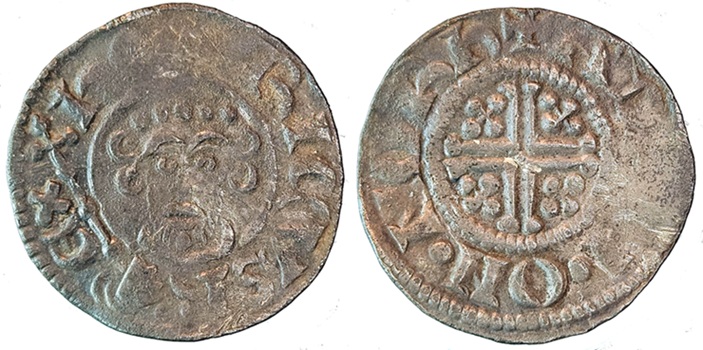
Henry II – Penny (Class 1b), York Mint (1180–1189)
Mint: York
Obverse:
+hENRICVS REX
Crowned facing bust with sceptre
Reverse:
+ HVNFREI ON EVER
“Hunfreid of York”; Voided short cross with quatrefoils of pellets in angles within inner beaded circle, moneyer and mint name around.
Historical Note: The 1180 reform introduced a uniform portrait and reverse type across the kingdom.
The York issues of moneyer Hunfreid are among the best‑struck of the early classes and illustrate the improved quality
that defined Henry II’s monetary system.
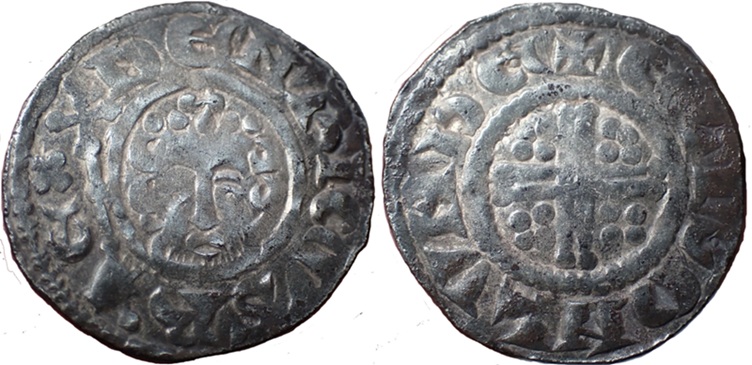
Henry II – Penny (Class 1c), Winchester Mint (1180–1189)
Mint: Winchester
Obverse:
+hENRICVS REX
Crowned facing bust with sceptre
Reverse:
+ GOCELM ON WINC
“Gocelm of Winchester”; Voided short cross with quatrefoils of pellets in angles within inner beaded circle, moneyer and mint name around.
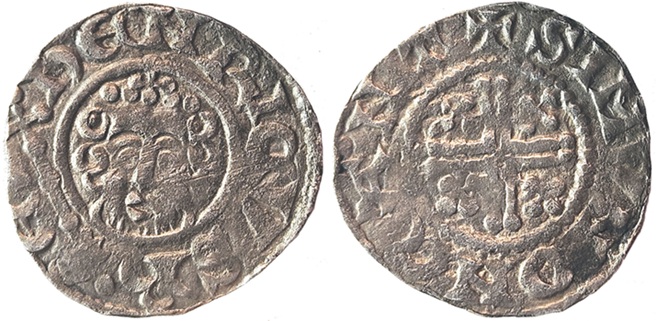
Henry II – Penny (Class 1), Winchester Mint (1180–1189)
Mint: Winchester
Obverse:
+hENRICVS REX
Crowned facing bust with sceptre
Reverse:
+ DAVI ON LVND
“Davi of London”; Voided short cross with quatrefoils of pellets in angles within inner beaded circle, moneyer and mint name around.
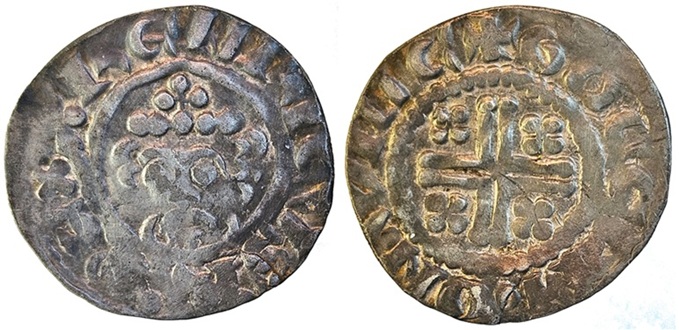
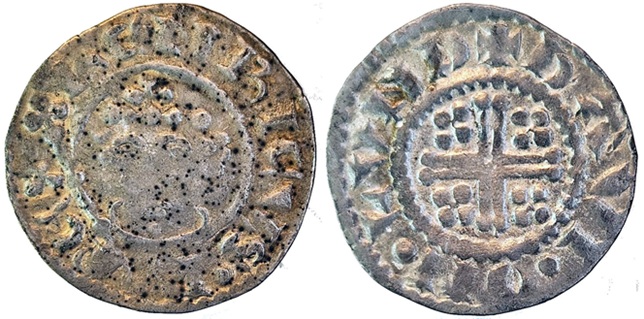
Richard I ascended to the throne inheriting the stable and standardized short cross monetary system established during his father Henry II's 1180 reform.
While the pennies minted between 1189 and 1199 continued to bear the generic name hENRICVS, they formed the crucial currency of the Lionheart's reign,
maintaining the fine silver standard that served as the backbone of English commerce before passing to his brother John and eventually into the reign of
Henry III.
Details
Ruler
Image
Richard I – Penny (Class 3ab - 4b), London Mint (1189 - 1199)
Mint: London
Obverse:
+hENRICVS REX
Crowned facing bust with sceptre
Reverse:
+ STIVENE ON LVN
“Steven of London”; Voided short cross with quatrefoils of pellets in angles within inner beaded circle, moneyer and mint name around.
Richard I – Penny (Class 4b), London Mint (c.1200-1204)
Mint: London
Obverse:
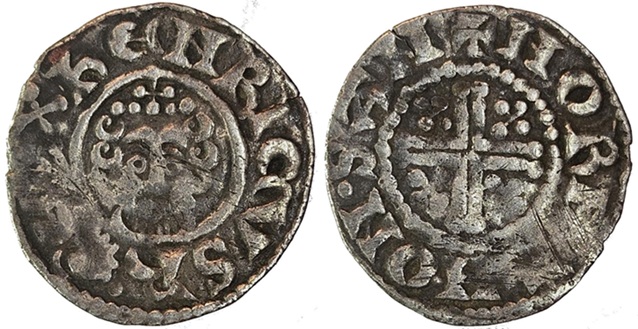
+hENRICVS REX
Crowned facing bust with sceptre
Reverse:
+ hENRI ON LVN
“Henri of London”; Voided short cross with quatrefoils of pellets in angles within inner beaded circle, moneyer and mint name around.
King John, remembered for being forced to accept Magna Carta in 1215, is one of the most famous English medieval monarchs.
His reign also forms the backdrop for the Robin Hood legends, where he is often cast as the villain. John continued the
short‑cross penny coinage introduced under his father, Henry II, and the obverse legend still reads hENRICVS REX,
a convention that remained unchanged until the long‑cross reform of 1247.
Details
Ruler
Image
John – Penny (Class 4b-5c), Canterbury Mint (c.1200-1210)
Mint: Canterbury
Obverse:
(hENR)ICVS (REX)
Crowned facing bust with sceptre
Reverse:
+ ARN (AUD ON CANT)
“Arnaud of Canterbury”; Voided short cross, with four pellets in angles
Historical Note: Class 5c. In the time of King John, Ilger was the Middle English evolution of an ancient Continental Germanic personal name introduced by the Normans. It was composed of two fierce elements:
Hild (meaning strife or battle)
Gār / Gēr (meaning spear)
In parts of Eastern England, it also blended with the Old Danish cognate name Hildiger
John – Penny (Class 6a), London Mint (1210–1213)
Mint: London
Obverse:
hENRICVS REX
Crowned facing bust with sceptre
Reverse:
+ RAVF ON LVN
“Rauf of London”; Voided short cross with quatrefoils of pellets in angles within inner beaded circle, moneyer and mint name around.
Historical Note: Although the obverse legend still names Henry, stylistic features such as the
portrait, lettering, and moneyer signatures allow precise classification of John’s short‑cross pennies. Class 6a is
among the later issues of his reign, struck shortly before the turmoil surrounding Magna Carta.
John – Penny (Class 6) London mint (1218–1225)
Mint: London
Obverse:
CVSR CVSR
Crowned bust facing, with sceptre, within beaded inner circle
Reverse:
+RON LUNDE+LVND
Voided short cross, with four pellets in angles (Probably Rener of London)
Historical Note: Obviously a difficult coin to fully identify. It appears to have been struck - then the coin has rotated some 250 degrees and restruck.
Another point of diagnostic include the underlying tip of the Kings beard at 2 o'clock.
The first letter of the name is clearly R and there seems to be space for an additional 4 letters which would suggest RENER as the most likely
John – Penny (Class 5b1), Kings Lynn Mint (1205)
Mint: Kings Lynn
Obverse:
hENRICVS REX
Crowned facing bust with sceptre
Reverse:
+ WILLELM ON LE
“Williem of Kings Lynn”; Voided short cross with quatrefoils of pellets in angles within inner beaded circle, moneyer and mint name around.
John – Penny (Class 5b2), Northampton Mint (1205-1207)
Mint: Northampton
Obverse:
hENRICVS REX
Crowned facing bust with sceptre
Reverse:
+ ADAM ON NORH
“Adam of Northampton”; Voided short cross with quatrefoils of pellets in angles within inner beaded circle, moneyer and mint name around.
Historical Note: Historical records place the moneyer Terri in London starting around 1222.
This coin belongs to the later stages of the Short Cross series, specifically Class 7. The broad consensus for the production of Class 7 is roughly 1222–1236.
Henry III – Penny (Class 7b1), London Mint (ND c.1220-1222)
Mint: London
Obverse:
hENRICVS REX
Crowned facing bust with sceptre
Reverse:
+ ELIS ON LUNDE
“Elis of London”; Legend around voided short cross, with four pellets in angles.
Historical Note: Generally speaking LVND is seen on earlier issues and LVNDE is seen on later issues - but this is by no means a rule as it is very much
governed by space management.
Henry III – Penny (Class 7b2), Canterbury Mint (c.1229-c.1232)
Mint: Canterbury
Obverse:
+HENRICVS REX
Crowned facing bust with sceptre Reverse:
TOMAS ON CANT
“Tomas of Canterbury”; Short voided cross with four pellets in angles
Historical Note: Class 7b2 pennies was struck during the period when Hubert de Burgh was effectively governing England on behalf of
the young Henry III. The kingdom was recovering from the turmoil of King John's reign and the First Barons' War, and the Canterbury mint was producing
enormous quantities of pennies to support a stabilising economy. Tomas was one of the officials responsible for that output though little is known about him.
Henry III – Penny (Class 7b2), Canterbury Mint (c.1229-c.1232)
Mint: Canterbury
Obverse:
+HENRICVS REX
Crowned facing bust with sceptre Reverse:
SIMVN ON CANT
“Simon of Canterbury”; Short voided cross with four pellets in angles
Henry III – Penny (Class 7), Canterbury (1217-1236)
Mint: Canterbury
Obverse:
+hENRICVS REX
Crowned facing bust with sceptre
Reverse:
+ SINVN ON CANTE
“Simon of Canterbury”; Voided short cross with quatrefoils of pellets in angles within inner beaded circle, moneyer and mint name around.
Mass mentions this reverse spelling - but doesn not illustrate it.
Henry III – Penny (Class ?), Bury St Edmunds Mint (c.1229-c.1232)
Mint: Bury St Edmunds
Obverse:
+HENRICVS REX
Crowned facing bust with sceptre Reverse:
NORMAN ON SAN
“Norman of Bury St Edmunds”; Short voided cross with four pellets in angles
England – PLANTAGENET - Henry III (1216–1272) - Long Cross Pennies
English Long Cross Pennies of Henry III — (1247–1279) The table below gives a breakdown of the classes, the dates they were minted between and a general sense of the rarity.
Transition to sharper details; narrow busts, variety of local and royal moneyers.
Class 3
c. 1248–1250
C
Major high-output group (divided into sub-classes 3a–3g, including your London Class 3b); varied hair curls and lettering details.
Class 4
c. 1250–1253
C
Sub-divided into 4a, 4b, and 4c; features broader faces and distinct bust shapes.
Class 5
c. 1253–1272
C
Longest-running mass production class of the series (sub-classes 5a–5g); wide chronological span carrying through the later years of Henry III's reign.
Class 6
c. 1270–1278
S
Late transitional phase leading toward the end of the long cross currency.
Class 7
c. 1278–1279
R
Final rare experimental issue right on the cusp of Edward I's 1279 comprehensive recoinage.
The below examples are of Henry III Long cross pennies.
Details
Ruler
Image
Henry III – Penny (Class 3a), London Mint (1248–1249)
Mint: London
Obverse:
*
* hENRICVS REX III
Crowned facing bust without sceptre
Reverse:
NICOLE ON LVND
“Nicole of London”; long voided cross with trefoils
Historical Note: Nicholas de St Albans was the mintmaster at the London mint until his death in 1253. He oversaw the initial Class 1a pennies minted at London
(which did not bear a moneyer's name on the reverse) and his name (NICOLE) began explicitly appearing on the reverses starting with Class 2 in 1248.
Historical records indicate that he held unique responsibility across multiple major locations, being responsible for both the London and
Canterbury mint operations.
Henry III – Penny (Class 3b), London Mint (1248–1249)
Mint: London
Obverse:
*
* hENRICVS REX III
Crowned facing bust without sceptre
Reverse:
HENRI ON LVNDE
“Henry of London”; long voided cross with trefoils
Historical Note: This issue belongs to the early Long Cross coinage, introduced to combat clipping by
extending the cross to the edge of the flan. The specific arrangement of four curls, each with a central pellet, is the key technical
marker used to distinguish the Class 3b sub-type from other 3-series variants
Henry III – Penny (Class ?), London Mint (1248–1249)
Mint: London
Obverse:
*
* hENRICVS REX III
Crowned facing bust with sceptre
Reverse:
RICARD ON LVND
“Richard of London”; long voided cross with trefoils
Historical Note: William of Canterbury was one of the most prolific moneyers of Henry III’s reign,
active across multiple classes of the Short Cross series.
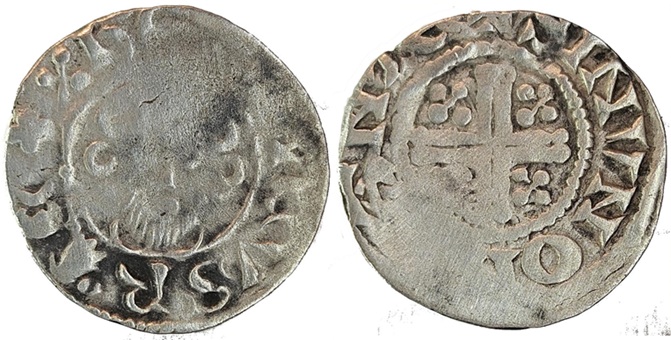
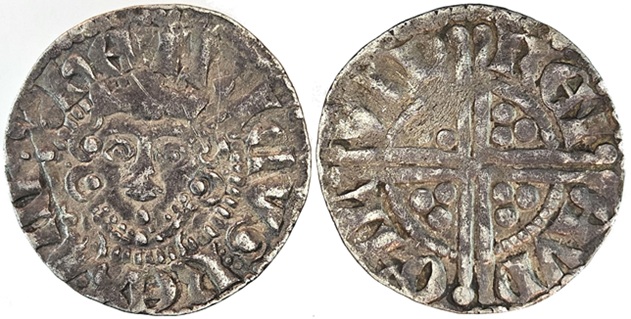
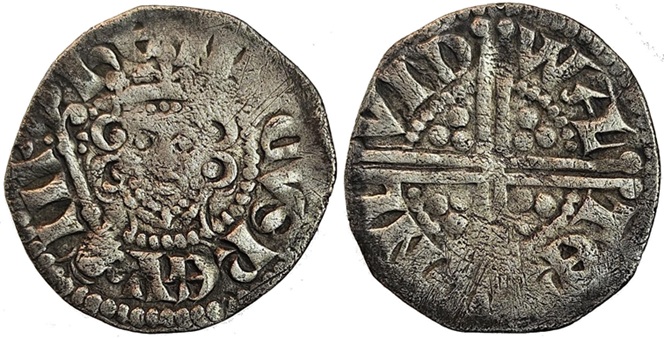
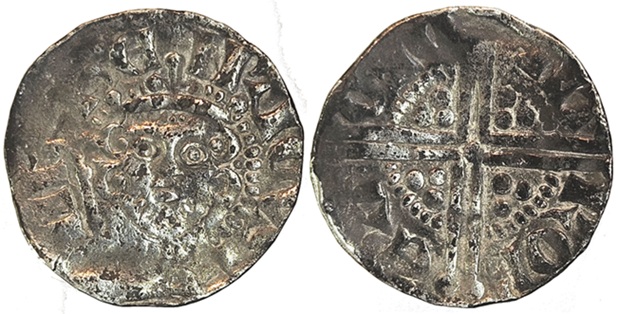
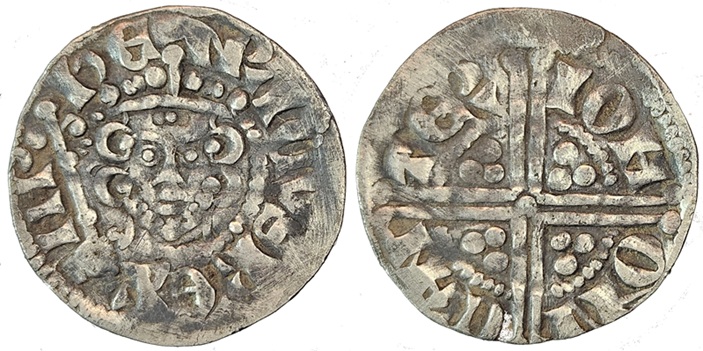
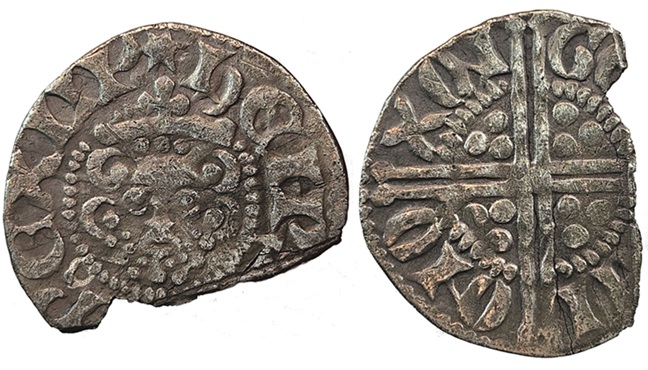
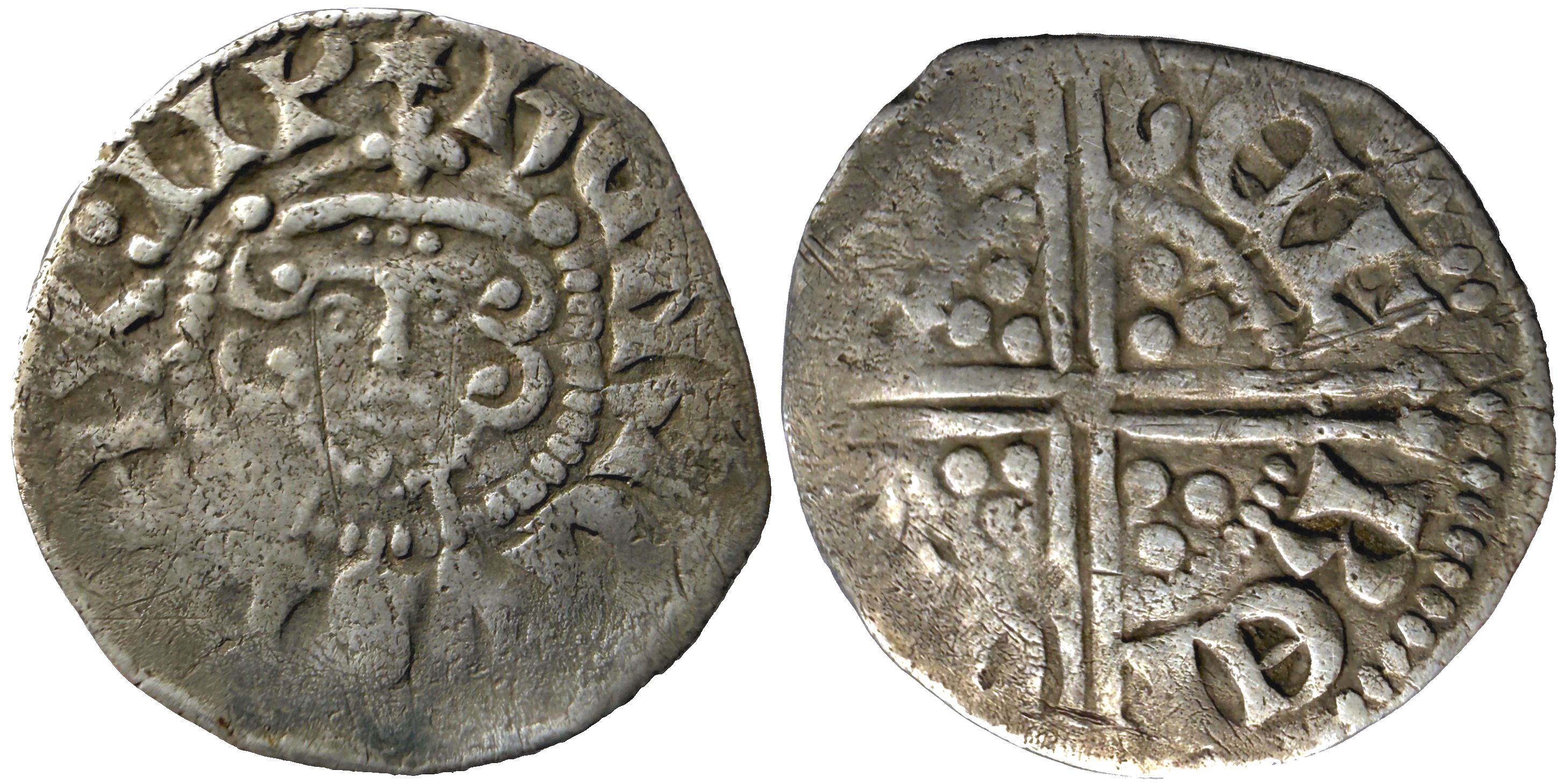
Henry III – Penny (Class 3b), Gloucester Mint (1249)
Mint: Gloucester
Obverse:
+HENRICVS REX III
Crowned facing bust without sceptre Reverse:
ION ON GLO VCE
“Roger of Gloucester”; long voided cross with trefoils
The first long cross penny was introduced by Henry III in 1247, but when Edward I came to the throne the English currency was
still in crisis. The old short‑cross pennies had circulated for decades and were heavily clipped, reducing their silver
content and undermining trade. Edward’s Great Recoinage of 1279 replaced all earlier issues with a new, standardized long
cross coinage featuring a revised portrait and consistent legends. New mints were opened across the country to meet the
unprecedented demand. Edward’s pennies became the standard currency for the next two centuries and inspired numerous
continental imitations.
Edward I & II — Penny (1279–1327) The table below gives a breakdown of the classes, the dates they were minted between and a general sense of the rarity.
Class Group
Approx. Minting Years
Rarity
Key Notes / Reign
Class 1
1279
R
Edward I (Sub-types 1a–1d; London only)
Class 2
c. 1280
S
Edward I (Short-lived wedge-mark issue)
Class 3
1280–1281
C
Edward I (Large output, multiple sub-types 3a–3g)
Class 4
1282–1289
C
Edward I (Comma contraction marks)
Class 5
1289–1291
C
Edward I (Distinct wide side-fleurs, pellet on breast)
Class 6
c. 1292–1295
S
Edward I (Scarcely encountered transitional style)
Class 7
c. 1294–1296
C
Edward I (Sub-divided into 7a, 7b, 7c)
Class 8
c. 1296–1298
C
Edward I (Includes rare local mint variations)
Class 9
c. 1299–1300
S
Edward I (Often features a star on the breast, e.g., 9b)
Class 10
1301–1310
C
Edward I (Split into primary & secondary phases bridging into Edward II)
Class 11
c. 1310–1314
S
Edward II (Began under Edward II)
Class 12
c. 1314–1317
R
Edward II (Non-fleured central crown ornaments)
Class 13
c. 1315–1317
R
Edward II (Battle-axe shaped central fleur)
Class 14
c. 1317–1318
R
Edward II (Scarcely minted short issue)
Class 15
c. 1318–1327
S
Edward II / III (Transitioning into early Edward III)
Mints of the Great Recoinage: To support the massive currency overhaul of 1279, silver pennies were produced across an expanded
network of royal and ecclesiastical mints. While major centers stayed open long-term, many provincial operations were strictly temporary responses
to regional demand. The below table lists the mints with a commonly encountered lettering - though many varieties exist
Major Royal Mints
London CIVITAS LONDON
Canterbury CIVITAS CANTOR
Bristol VILL BRISTOLIE
Provincial Royal Mints
Chester CIVITAS CESTRIE
Exeter CIVITAS EXONIE
Kingston upon Hull VILL KYNCESTON
Lincoln CIVITAS LINCOL
Newcastle VILL NOVI CASTRI
Ecclesiastical Mints
Bury St Edmunds VILLA S EDMVNDI
Durham CIVITAS DVNELM
York (Royal & Episcopal) CIVITAS EBORACI
Northern Border Mint
Berwick-upon-Tweed VILLA BERREWYCI
Details
Ruler
Image
Edward I – Farthing, London Mint
Mint: London
Obverse:
+E R ANGLIE
Crowned facing bust, bifoliate crown, Cross potent, legend
Reverse:
LONDONIENSIS
“City of London”; Long cross pattée with trefoils Denomination: Farthing
Historical Note: The obverse is highly truncated as you might expect on such a small flan - +E R ANGLIE, meaning EDWARDUS REX ANGLIE
Edward, King of England
Edward I – Halfpenny, London Mint
Mint: London
Obverse:
+EDW R ANGL DNS hYB
Crowned facing bust, bifoliate crown, Cross potent, legend
Reverse:
CIVITAS LONDON
“City of London”; Long cross pattée with trefoils Denomination: Halfpenny
Historical Note: Edwardian halfpennies were struck on small flans but maintained the same portrait
and reverse style as the pennies, ensuring consistency across denominations.
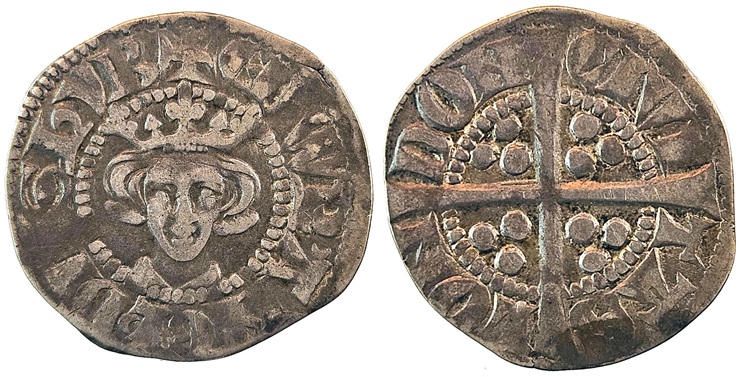
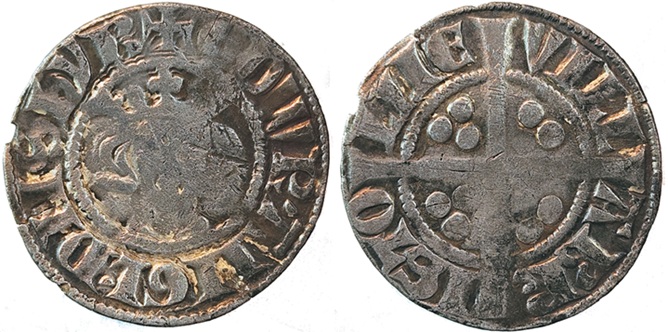
Edward I – Penny (Class 3d), London Mint (1280–1281)
Mint: London
Obverse:
+EDW R ANGL DNS hYB
Crowned facing bust, bifoliate crown, Cross potent, legend
Reverse:
CIVITAS LONDON
“City of London”; Long cross pattée with trefoils
Historical Note: Class 3g belongs to the early phase of Edward’s recoinage, showing the crisp portrait
style and consistent lettering that defined the 1279 reform.
Edward I – Penny (Class 4b), London Mint (1282-1289)
Mint: London
Obverse:
+EDW R ANGL DNS hYB
Crowned facing bust within beaded circle
Reverse:
+CIVITAS LONDON
“City of London”; Long cross pattée with trefoils of pellets
Historical Note: Class 9 pennies show subtle stylistic changes in the portrait and lettering, marking
the transition toward the later Edwardian issues.
Edward I – Penny (Class 10cf2), London Mint (ND 1306–1307)
Mint: London
Obverse:
+EDWA R ANGL DNS hYB
Crowned facing bust within beaded circle
Reverse:
CIVITAS LONDON
“City of London”; Long cross pattée with trefoils of pellets
Historical Note: Class 10cf2 is one of the final issues of Edward I’s reign, showing the mature
portrait style that continued into the earliest coins of Edward II.
Edward I – Penny (Class 9b), Bristol Mint (1300–1302)
Mint: Bristol
Obverse:
+EDW R ANGL DNS hYB
Crowned facing bust within beaded circle
Reverse:
+VILL BRISTOLIE
“Town of Bristol”; long cross pattée with trefoils
Historical Note: Bristol was one of the most active provincial mints during Edward’s recoinage.
Class 9b pennies show the evolving portrait style of the late Edwardian series.
Edward I – Penny (Class 5?), Canterbury Mint (ND 1302–1310)
Mint: Canterbury
Obverse: +EDWA R ANGL DNS hYB
— Crowned facing bust within beaded circle
Reverse:
CIVITAS CANTOR
“City of Canterbury”; long cross pattée with trefoils
Historical Note: Canterbury was one of the principal mints of the Edwardian series.
The exact class of this issue is debated, as some stylistic features overlap with both late 4‑series and early 5‑series dies.
Edward I – Penny (Class 10cf1), Canterbury Mint (1305–1306)
Mint: Canterbury
Obverse:
+EDWA R ANGL DNS hYB
Crowned facing bust within beaded circle
Reverse: CIVITAS CANTOR
— “City of Canterbury”; long cross pattée with trefoils
Historical Note: Class 10cf1 is part of the late Edwardian series, showing the mature portrait style
that bridges the final issues of Edward I and the earliest issues of Edward II.
Edward I – Penny (Class 10ab), Canterbury Mint (1301–1305)
Mint: Canterbury
Obverse:
+EDWAR R ANGL DNS hYB
Crowned facing bust within beaded circle
Reverse: CIVITAS CANTOR
“City of Canterbury”; long cross pattée with trefoils
Historical Note: Bury St Edmunds was one of the most distinctive provincial mints of the Edwardian
series. Moneyer Robert de Hadeleie is well‑attested in the early 4‑series issues, and his coins often show slightly
different portrait engraving compared to the London dies.
Edward I – Penny (Class 8a), Bury St Edmunds Mint (1294–1299)
Mint: Bury St Edmunds
Obverse:
+EDW R ANGL DNS hYB
Crowned facing bust within beaded circle
Reverse:
VILA SCI EDMVNDI
“Town of St Edmund”; long cross pattée with trefoils
Historical Note: This issue comes from Edward I’s massive recoinage layout of 1279–1281, which
called in and melted down the old, worn short and long cross pennies that had
circulated for decades. To handle the sheer volume of silver, regional mints like
Lincoln were temporarily reopened to striking capacity.
Edward I – Penny (Class 3e), London Mint (1282–1289)
Mint: London
Obverse:
+EDW R ANGL DNS hYB
Crowned facing bust within beaded circle
Reverse:
+CIVITAS LINCOL'
“City of Lincoln”; Long cross pattée with trefoils of pellets
Edward II inherited the late Edwardian long‑cross coinage, which had already been in use for nearly thirty years. His early
pennies continue the Class 11 style of his father, Edward I, with only subtle differences in portrait engraving and
lettering. As a result, distinguishing the earliest Edward II issues relies heavily on die‑study and mint‑period
classification rather than legend changes. His reign saw no major coinage reform, and the long‑cross design remained
unchanged until the introduction of the Edward III florin coinage in 1344.
Details
Ruler
Image
Edward II – Penny (Class 11), London Mint (ND 1310–1314)
Mint: London
Obverse:
+ EDWAR ANGL DNS HYB
Crowned facing bust within beaded circle
Reverse:
CIVI TAS LON DON
“City of London”; long cross pattée with trefoils
Historical Note: Early Edward II pennies are nearly indistinguishable from the final issues of
Edward I. Class 11 is transitional, and many dies were likely engraved by the same craftsmen working across both reigns.
Edward II – Penny (Class 11), London Mint (1310–1314)
Mint: London
Obverse:
+EDWAR ANGL DNS hYB
Crowned facing bust within beaded circle
Reverse:
CIVITAS LONDON
“City of London”; Long cross pattée with trefoils of pellets
Historical Note: Class 11 pennies overlap the end of Edward I’s reign and the beginning of Edward II’s,
making them an important transitional issue in the Edwardian series.
England – PLANTAGENET - Edward III (1327–1377)
The pennies of Edward III fall into three major phases: the Pre‑Treaty Coinage (1344–1361),
the Treaty Coinage (1361–1369), and the Post‑Treaty Coinage (1369–1377).
These divisions reflect political changes following the Treaty of Brétigny in 1360, in which Edward III temporarily
renounced his claim to the French throne in exchange for sovereignty over his continental possessions.
Although this French claim appears only on higher denominations, the penny series follows the same classification system.
Details
Ruler
Image
Edward III – Penny (Pre‑Treaty), London Mint (ND 1344–1351)
Mint: London
Obverse:
+ EDW ANGL DNS HYB
Crowned facing bust within beaded circle
Reverse:
CIVITAS LONDON
“City of London”; long cross pattée with trefoils
Historical Note: This early issue belongs to the Pre‑Treaty coinage, struck during the height of the
Hundred Years’ War. The portrait style continues the late Edward II tradition but with sharper engraving and more
consistent lettering.
Edward III – Penny (Post‑Treaty), London Mint (ND 1369–1377)
Mint: London
Obverse:
.
.
EDWARDVS . REX . ANGLIE
Crowned facing bust with annulet on breast
Reverse:
CIVITAS LONDON
“City of London”; long cross pattée with trefoils
Historical Note: The Post‑Treaty coinage reflects Edward’s renewed claim to the French throne after
hostilities resumed in 1369. The annulet on the king’s breast is a key diagnostic feature of this late series.
Edward III – half Groat (Pre‑Treaty), London Mint (ND 1351-1352)
Mint: London
Obverse:
.
.
.
.
EDWARDVS . REX . ANGLIE . Z . FRANCI
Crowned facing bust within tressure of arches, mintmark at 12 o'clock, legend around.
Reverse:
.
.
.
.
POS VI DEV ADIVT OREM / CIVITAS LONDON
"I have made God my helper" / “City of London”; Long cross pattée with three pellets in each quarter, two circles of legend around.
Richard II, known as Richard of Bordeaux, was the son of the Black Prince and grandson of Edward III. His pennies are
traditionally divided into several classes that reflect the political turbulence of his reign. The earliest issues were
struck as part of the great recoinage of 1377, replacing the worn late‑Edward III currency. Later issues show subtle changes
in portrait style and lettering, corresponding to periods of baronial opposition and political instability. Accusations of
mismanagement and debasement contributed to Richard’s downfall, culminating in his deposition in 1399 by Henry Bolingbroke
(Henry IV), his first cousin.
Details
Ruler
Image
Richard II – Penny, York Mint (1391–1396)
Mint: York
Obverse:
+RICARDVS REX AnGLE
Crowned facing bust, pellets above shoulders
Reverse:
CIVITAS EBORACI
“City of York”; long cross pattée with trefoils, quatrefoil in centre
Historical Note: York was one of the principal provincial mints during Richard II’s reign.
The quatrefoil at the centre of the reverse cross is a key diagnostic feature of this issue, helping distinguish it
from contemporary London and Durham pennies.
England – HOUSE of LANCASTER - Henry VI (1422–1461 & 1470–1471)
Henry VI ascended the throne as an infant and reigned during one of the most turbulent periods in English history. His
coinage reflects the political instability of the Wars of the Roses, with issues struck both during his long first reign
and his brief restoration in 1470–1471. The small denominations, such as halfpennies, continued the traditional long‑cross
design established in the 13th century, with only minor stylistic changes distinguishing them from earlier Plantagenet
issues. London remained the principal mint, producing large quantities of small silver to support everyday commerce during
a period of economic strain and civil conflict.
Details
Ruler
Image
Henry VI – Halfpenny, London Mint (ND 1431–1432)
Mint: London
Obverse:
+ HENRIC REX ANGL
Crowned facing bust within inner circle
Reverse:
CIVITAS LONDON
“City of London”; long cross pattée with trefoils
Historical Note: Early Henry VI halfpennies closely follow the late Henry V style, with only subtle
differences in portrait engraving. These small denominations were essential for everyday transactions during the
economically strained early years of Henry’s minority government.
England – HOUSE of LANCASTER - Henry VII (1485–1509)
Henry VII’s coinage marks the beginning of the Tudor monetary system. His early issues continued the late medieval
long‑cross style, but his reign also introduced clearer portraits, improved mint organisation, and greater consistency in
silver fineness. The half‑groat (two‑pence piece) was an important small denomination widely used in everyday commerce.
Canterbury was one of the principal provincial mints operating under episcopal authority, producing distinctive coins with
its own mint signature.
Details
Ruler
Image
Henry VII – Half‑Groat, Canterbury Mint (1493–1498)
Mint: Canterbury
Obverse:
Z
+ hEnRIC DI GRA REX AnGL Z Fr
Crowned facing bust within tressure of arches
Reverse:
POSVI DEV A DIVTO R MEV / CIVI TAS CAn TOR
“I have made God my helper / City of Canterbury”;
long cross fourchée with trefoils
Historical Note: Canterbury half‑groats of Henry VII are notable for their clear portrait style and
distinctive mint signature. The long cross fourchée design continued a tradition dating back to the 13th century, but
the lettering and tressure reflect the emerging Tudor aesthetic.
Ireland – James I (1177-1216)
Details
Ruler
Image
John Penny (ND 1177-1216)
Mint: Royal Irish Mint, Dublin
Obverse:
IOhA NNES RE X
Crowned facing bust, holding cruciform scepter; rosette to right; all within triangle, legend around
Reverse:
✠ ROBЄ ✠ RD ON ✠ DIVЄ
Pinwheel (sun) within crescent moon; three stars around; all within triangle; three crosses pattée, legend around
A striking feature of the coinage of James I of Cyprus is the frequent appearance of the lion passant guardant. This emblem
represents the Kingdom of Armenia, whose throne James claimed through his marriage to his cousin, the Armenian princess
Euphémie de Lusignan. His deniers perfectly illustrate the complex political identity of the Lusignan kings: the obverse
typically bears his name and a Latin cross, reflecting his Frankish Crusader heritage, while the reverse displays the
Armenian lion, asserting his dynastic claim to Armenia. Although the Armenian kingdom had fallen to the Mamluks in 1375,
James I and his successors continued to use the lion on their coinage as a symbolic assertion of legitimacy.
Details
Ruler
Image
James I – Denier (ND 1382–1398)
Mint: Uncertain (Cyprus)
Obverse: Q
.
+ IAQVE REI . D
Cross with legend around
Reverse:
3
+ IERV3m REI C
Armenian lion passant guardant
Historical Note: The Armenian lion on the reverse is one of the most recognisable symbols of the
Lusignan kings of Cyprus. Its continued use long after the fall of the Armenian kingdom reflects the dynasty’s
determination to maintain its hereditary claims and prestige.
Spain, Castile and León – Fernando IV (1295–1312)
Fernando IV, known as “the Summoned,” inherited a kingdom facing severe financial strain. To raise funds quickly, he
authorised the mass production of the pepión, a low‑value billon coin. Its extremely small silver content and
enormous output led to rapid debasement and widespread inflation. Pepiones were typically crude in style and poorly struck,
yet they remain historically important as reflections of the economic pressures of late‑13th‑century Castile.
This example features the castle of Castile on the obverse and the lion of León on the reverse — the traditional emblems of
the united realms. Pepiones were struck at several mints, including Seville, Burgos, León, Toledo, and Córdoba.
Details
Ruler
Image
Fernando IV – Pepión (ND 1295–1312)
Mint: Burgos
Obverse:
F REX CASTELLE
“Fernando, King of Castile”; castle of Castile
Historical Note: Pepiones of Fernando IV are among the most debased medieval Iberian issues.
Their crude fabric and low silver content reflect the kingdom’s financial crisis and the urgent need for circulating
small change during his troubled reign.
Spain, Castile and León – Henry IV (1471–1474)
The blanca of Henry IV is a classic example of late‑medieval Castilian debasement. Although the name “blanca”
means “white,” referring to silver, these coins contained almost none — their reddish tone betrays their extremely low
silver content. Minted in vast quantities to fund Henry’s costly wars and political struggles, the blanca contributed to
severe inflation and widespread economic instability. The design is crude and often poorly executed, with the castle of
Castile on the obverse and the lion of León on the reverse. These issues were struck at several mints, including Seville,
Toledo, Burgos, Ávila, and Cuenca, during the turbulent final years of Henry’s reign. His death and the ensuing succession
crisis paved the way for the rise of his half‑sister Isabella I, whose marriage to Ferdinand II would unite Spain.
Details
Ruler
Image
Henry IV – Blanca (1471–1474)
Mint: Uncertain (likely Seville, Toledo, Burgos, Ávila, or Cuenca)
Obverse:
ENRICVS DEI GRA REX C
“Henry, King by the grace of God”; castle of Castile
Historical Note: These late blancas are among the most debased Castilian issues. Their poor fabric,
low silver content, and crude execution reflect the financial collapse of Henry IV’s reign and the political turmoil
that ultimately led to the rise of Isabella I and the unification of Spain.
Hungary – Maria (1382–1385)
Maria inherited the Hungarian throne from her father, Louis I, at a young age. Her brief reign was marked by political
instability, rival claimants, and shifting alliances. The coinage of this period reflects that uncertainty: the quality
declined sharply from the well‑struck issues of her father, symbolising a monarchy whose authority was under constant
challenge.
This quarting (denar) was struck at the important royal mint of Nagybánya (modern Baia Mare, Romania), a major
centre of precious‑metal mining in Transylvania. The obverse shows a crown above a large “M,” the mintmark of Nagybánya.
The reverse features the Hungarian patriarchal cross — the double‑barred cross long associated with the Hungarian monarchy.
Details
Ruler
Image
Maria – Quarting (1382–1385)
Mint: Nagybánya (Baia Mare)
Obverse:
+REGInE VnGARIE
“Maria, Queen of Hungary”; crown above mintmark “M” within pearl circle
Reverse:
+mOnETA mARIE
“Money of Maria”; patriarchal cross within pearl circle Date: ND (1382–1385), Quarting (Denar)
Historical Note: Coins of Maria’s reign are noticeably cruder than those of Louis I, reflecting the
political turmoil of the period. Despite this, the Nagybánya mint remained one of the most important in the kingdom,
producing large quantities of small silver for everyday commerce.


 1015-1036 +COMES CENOMANNIS +SIGNVM DEI VIVI 1.04g 20mm.jpg)
 1015-1036 +COMES CENOMANNIS +SIGNVM DEI VIVI 1.03g 19mm.jpg)


 LODOICVS - EGOLISSIME.jpg)


 Denier 1100-1300.jpg)


, Province de Bearn Duplessy 1241, Boudault 525.jpg)


.jpg)


 1307-1313. Denier Lepanto mint Malloy 111a.jpg)


.jpg)


 Penny hENRI ON LVN.jpg)





.jpg)






 Penny ION ON GLOVCE.jpg)


 Farthing LOMDONIENSIS Type 3d.jpg)



 penny London mint.jpg)




 1 Penny 1280 - 1281 Type 3d 1.5g.jpg)


 Group 4 London mint.jpg)
 Penny York mint Type 3E.jpg)


 .
.